We use cookies to improve our site and your experience. By continuing to browse our site you accept our cookie policy
We use cookies to improve our site and your experience. By continuing to browse our site you accept our cookie policy
 27.8.2026
Six of Friday afternoon’s eight World Championship finals are already fully formed, with only the VL1 Men and Women 200m line-ups still to be completed through Friday morning’s semifinals. Across those six confirmed Final A fields, 43 of the 54 available places belong to European athletes or crews – 79.6 per cent.
Nowhere is that dominance more visible than in the two K4 500m finals, which will open the World Championship medal programme on Friday afternoon. Of the 18 boats lining up across the men’s and women’s finals, 15 are European.
And in the men’s race, Europe has gone even further: eight of the nine finalists come from the continent.
Portugal’s title defence faces a formidable European challenge
The K4 Men 500m final promises to be one of the races of the championships.
Australia is the only non-European boat to have made the Final A. Alongside them will be Denmark, Serbia, Germany, Poland, Hungary, Lithuania, Portugal and Spain, creating a race packed with Olympic champions, World Championship medallists and some of the leading crews in the new LA28 ranking cycle.
For Portugal, Friday is about defending the world title won in Milan one year ago.
Gustavo Gonçalves, João Ribeiro, Messias Baptista and Pedro Casinha began their championships by winning their heat in 1:24.69, ahead of Hungary, before confirming their place in the medal race on Thursday. In a remarkably tight third semifinal, Lithuania won in 1:24.51, Portugal followed just 0.10 seconds behind, with Spain another 0.18 seconds back.
The Portuguese crew’s season suggests they have been building towards this moment. They finished fourth at the opening World Cup in Szeged, missing the podium by only 0.02 seconds, and were fourth again one week later in Brandenburg. In July, they moved onto the podium in Montreal, taking silver only 0.13 seconds behind Hungary.
Germany, however, arrives in the final with perhaps the most intriguing trajectory of all.
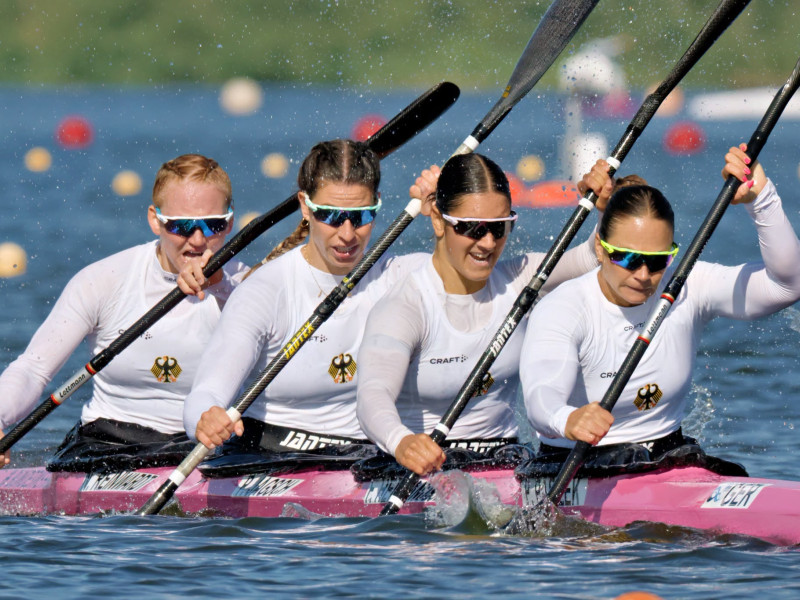
Max Rendschmidt, Max Lemke, Jacob Schopf and Tom Liebscher-Lucz were fifth in Szeged before responding by winning the second World Cup in Brandenburg. Their next World Cup appearance in Montreal ended very differently: with Rendschmidt ill and Jonas Borkowski taking his place, the German K4 won its heat but was later disqualified.
The full crew is reunited in Poznań and has responded emphatically. Germany won its heat on Wednesday and then won the second semifinal on Thursday, ahead of Poland and Hungary.
There is another layer to Friday’s race: Hungary, Germany and Portugal currently occupy the first three positions in the LA28 Olympic Qualification Ranking for Men’s K4, with Hungary on 3,900 points, Germany on 3,390 and Portugal on 3,300.
Add Lithuania, who produced the fastest time of the third semifinal, Spain’s experienced quartet of Adrian del Rio, Marcus Cooper, Carlos Arevalo and Rodrigo Germade, plus a strong Danish crew, and Portugal’s title defence looks anything but straightforward.
Spain, Germany and China shape the women’s K4 battle
The Women’s K4 500m provides another fascinating European story.
Three crews avoided the semifinals altogether by winning their heats: Germany, China and defending world champions Spain.
Germany’s Paulina Paszek, Finja Hermanussen, Pauline Jagsch and Nele Reinwardt produced the quickest heat result in 1:38.14, China followed with 1:38.68, while Spain’s Sara Ouzande, Lucia Val, Daniela Garcia Heredia and Barbara Pardo won the third heat in 1:39.33.
Thursday then added Australia, Poland and Denmark from the first semifinal, while AIN, Slovakia and Sweden progressed from the second.
That means seven of the nine Women’s K4 finalists are European, with only China and Australia coming from outside Europe.
The final also closely reflects the first months of the Olympic qualification race. China currently leads the Women’s K4 Olympic Ranking with 4,000 points, followed by world champions Spain on 3,700 and Germany on 3,240.
Spain were second behind China at the Brandenburg World Cup in May and will now have the opportunity to reverse that order with a world title on the line.
One major name is missing from the equation.
Eight-time Olympic champion Lisa Carrington announced earlier this year that she is expecting her first child and would not compete at the 2026 World Championships. Her absence leaves a very different New Zealand K4 from the one that won Olympic gold in Paris.
The New Zealand crew in Poznań – Olivia Brett, Jacqueline Kennedy, Greer Morley and Lucy Matehaere – reached Thursday’s semifinal but finished eighth and missed the Final A. Carrington had already confirmed in April that she would sit out the remainder of the 2026 season after the early World Cups while continuing to target LA28.
An all-European K1 Women 1000m final
If the K4 numbers underline European strength, the K1 Women 1000m goes one step further.Every athlete in Friday’s Final A is European.
Reigning world champion Zsóka Csikós won the first semifinal for Hungary, ahead of AIN’s Elena Mironchenko and Poland’s Weronika Marczewska. Denmark’s Pernille Brandstrup Knudsen led an entirely European top three in semifinal two alongside Estonia’s Elizaveta Fedorova and Czechia’s Barbora Betlachova.
Germany’s Caroline Heuser then produced the quickest semifinal time of the three races, winning in 4:20.63, ahead of Spain’s Laia Pelachs and Switzerland’s Franziska Widmer. Nine finalists. Nine European representatives.
For Csikós, the challenge will be to turn another solid qualification into a successful title defence, but Thursday showed there are several athletes capable of challenging the Hungarian.
Fuksa survives a tough semifinal as Europe takes seven C1 1000m places
The C1 Men 1000m Final A will also be dominated by Europe, which holds seven of the nine lanes.
Germany’s David Bauschke and Spain’s Pablo Crespo advanced behind China’s Shengyue Wu in the first semifinal, while Hungary’s Daniel Fejes won the second ahead of Brazil’s Isaquias Queiroz and AIN’s Zakhar Petrov.
The third semifinal provided one of Thursday’s most interesting results.
Moldova’s Serghei Tarnovschi won ahead of AIN’s Ivan Patapenka, while defending world champion Martin Fuksa had to settle for third – enough to reach the final, but a reminder that the Czech star will face serious opposition when he attempts to retain his title.
Fuksa also has a demanding Friday ahead. Before racing for the C1 1000m world title in the afternoon, he must contest the C1 Men 500m semifinals in the morning. He won his 500m heat on Wednesday and is the world-best-time holder in the distance.
Luzan remains on course in C2 Women 500m
Ukraine’s Liudmyla Luzan also remains firmly in the medal picture.
Luzan, who won four world titles in Milan last year, and Anastasiia Rybachok won their C2 Women 500m heat to qualify directly for the final. Spain’s Angels Moreno and Viktoria Yarchevska and Hungary’s Agnes Anna Kiss and Bianka Nagy also booked immediate places from the heats.
Thursday’s semifinals added China, AIN, Uzbekistan, Germany, Canada and Moldova.
Europe therefore occupies six of the nine positions in Friday’s C2 Women 500m final.
The C1 Men 200m produces the same European ratio – six of nine – with AIN’s Sergey Svinarev and Andrei Zholabau, Spain’s Pablo Graña, Romania’s Ilie Sprincean, Poland’s Oleksii Koliadych and Georgia’s Aleksandre Tsivtsivadze all through.
Defending world champion Artur Guliev of Uzbekistan is among the three non-European challengers after finishing second to Koliadych in the third semifinal.
One surprise already waiting for Saturday
Not every major name has survived the opening two days.
One of the most notable casualties came in the K1 Men 200m.
Hungary’s Gergely Balogh, whose 33.37 world-best mark is displayed at the top of the result sheets in Poznań, finished only fifth in his semifinal and will race the Final B rather than for the medals. The Final A, scheduled for Saturday, is nevertheless entirely European.
Serbia’s Marko Dragosavljevic, Italy’s Andrea Di Liberto and Slovenia’s Matevz Manfreda came through the first semifinal; Spain’s Carlos Arevalo, Slovakia’s Csaba Zalka and Ukraine’s Dmytro Danylenko advanced from the second; and Georgia’s Badri Kavelashvili, Lithuania’s Arturas Seja and Poland’s Wojciech Pilarz completed the nine from semifinal three. It is another 100 per cent European Final A, waiting for Saturday afternoon.
Pimenta, Kopasz and a heavyweight Friday morning
Before the first medals are awarded, Friday morning brings another decisive block of semifinals. Few will attract more attention than the K1 Men 1000m.
Defending world champion Bálint Kopasz opened his campaign by winning his heat in 3:48.02. Portugal’s Fernando Pimenta, the current leader of the Men’s K1 Olympic Qualification Ranking, also won his heat, while Australia’s Thomas Green, AIN’s Uladzislau Kravets, Argentina’s Agustin Vernice and USA’s Jonas Ecker were the other heat winners.
Pimenta has already enjoyed an outstanding World Cup season, winning the K1 1000m in Szeged and again in Montreal, and will now try to translate that form into a World Championship final. And if there is ready to break real records it’s the Portuguese this weekend.
The K1 Women 500m semifinals should be equally competitive.
Defending world champion Anna Puławska won her heat for host nation Poland, while Germany’s Pauline Jagsch, New Zealand’s Aimee Fisher, Australia’s Natalia Drobot and Hungary’s Zsóka Csikós also took heat victories. Portugal’s Teresa Portela progressed after finishing third behind Puławska in their race.
Friday morning will also decide finalists in the C1 Women and Men 500m, C2 Women 200m and C4 Men 500m, alongside several Paracanoe classes.
In KL2 Women, defending world champion Charlotte Henshaw has already secured her Final A place directly from the heats after producing 51.98, while fellow Briton Emma Wiggs and Germany’s Anja Adler are also already through.
By the time the morning session finishes, all eight World Championship finals scheduled for Friday afternoon will be complete.
The first title will be decided in the Women’s K4 500m at 15:04, followed seven minutes later by the Men’s K4. The C2 Women 500m, C1 Men 1000m, K1 Women 1000m and C1 Men 200m follow before the medal programme closes with the VL1 Men and Women 200m finals.
After two days dominated by qualification, Poznań is ready for medals.
And with almost 80 per cent of the places in the six Friday finals already completed belonging to Europe, the continent arrives at the first medal day in exactly the position suggested by last year’s World Championships: at the centre of the action.



© 2021 ECA