We use cookies to improve our site and your experience. By continuing to browse our site you accept our cookie policy
We use cookies to improve our site and your experience. By continuing to browse our site you accept our cookie policy
 13.9.2026
The Championships will officially open on Monday, 14 September, before competition begins on Tuesday. The U21 Men and U21 Women will be the first categories to enter the pitches, while the Senior Men and Senior Women start their campaigns one day later. The U21 world champions will be crowned on Saturday, while the senior titles will be decided on Sunday.
Duisburg 2026 will be the 16th edition of the Canoe Polo World Championships. It will also be the 10th World Championships staged on European soil, following Sheffield 1994, Aveiro 1998, Essen 2002, Amsterdam 2006, Milan 2010, Poznań 2012, Thury-Harcourt 2014, Syracuse 2016 and Saint-Omer 2022.
Germany will host the competition for the third time, after previously welcoming the canoe polo world in Essen in 2002.
The scale of this year’s World Championships is significant. A total of 359 matches are scheduled across six competition days, with 76 teams fighting for four world titles.
| Day | Main programme |
|---|---|
| Monday, 14 September | Official Opening Ceremony |
| Tuesday, 15 September | Day 1 – U21 Men and U21 Women begin; first matches from 09:00 |
| Wednesday, 16 September | Day 2 – Senior Men and Senior Women begin |
| Thursday, 17 September | Day 3 – All four categories in action |
| Friday, 18 September | Day 4 – Decisive group and progression matches |
| Saturday, 19 September | U21 finals – Women at 17:00 and Men at 17:40 |
| Sunday, 20 September | Senior finals – Women at 15:00 and Men at 15:40 |
The U21 competitions therefore run from Tuesday to Saturday, while the senior tournaments take place from Wednesday to Sunday.
Europe will once again form the backbone of the competition. 46 of the 76 teams – more than 60 per cent – represent European nations, coming from 15 European National Federations.
Europe provides 13 teams in Senior Men, 11 in Senior Women, 13 in U21 Men and nine in U21 Women.
Europe arrives in Duisburg holding three of the four current world titles.
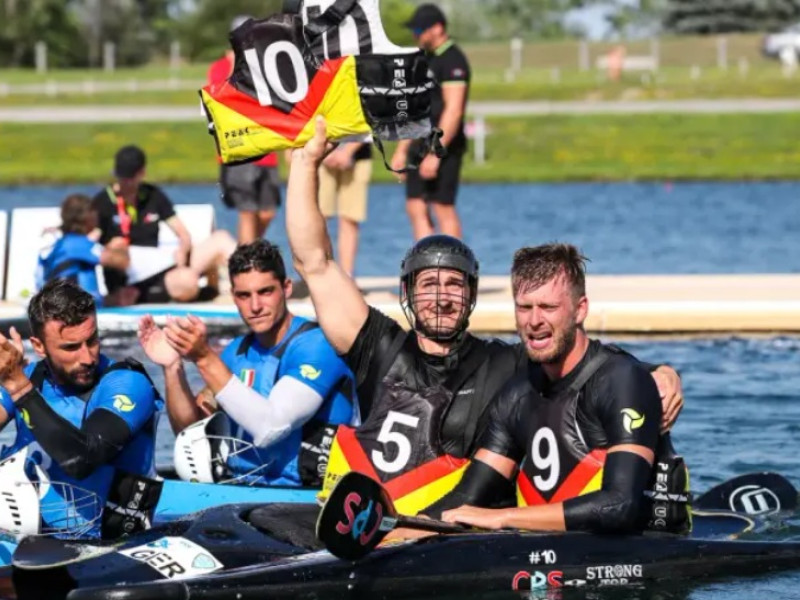
Germany are the reigning Senior Men world champions after winning the 2024 title in Deqing, China, ahead of France and Denmark. The German men have now won the last three editions of the World Championships – 2018, 2022 and 2024 – and will attempt to make it four consecutive titles on home water.
The only current senior world crown outside Europe belongs to New Zealand. The New Zealand women won the 2024 title ahead of Italy, with the Netherlands completing the podium.
Spain are the defending U21 Men world champions. Their 2024 victory gave them a second consecutive world title following Saint-Omer 2022, and their third U21 Men world crown overall after also winning in 2004. Denmark finished second in 2024, with France taking bronze.
France complete the European trio of defending world champions after winning the U21 Women title in Deqing, ahead of Spain and New Zealand.
The World Championships come almost exactly one year after the 2025 Paddle Europe Canoe Polo Championships in Avranches, France, where the four continental titles were shared between three nations.
Spain are the reigning European champions in Senior Men, Germany in Senior Women, France in U21 Men and Spain in U21 Women.
| Category | 2024 World Champion | 2025 European Champion |
|---|---|---|
| Senior Men | Germany | Spain |
| Senior Women | New Zealand | Germany |
| U21 Men | Spain | France |
| U21 Women | France | Spain |
That means European nations currently hold seven of the eight World and European Championship titles available across the four categories.
History shows that this European strength is far from new.
From the first official World Championships in Sheffield in 1994 through to Deqing 2024, there have been 48 official world-title events across Senior Men, Senior Women, U21 Men and U21 Women.
European countries have won 40 of those 48 world titles – 83.3 per cent.
The medal figures are even more impressive. Of the 144 gold, silver and bronze medals awarded in those official World Championship events, 126 have gone to European nations – 87.5 per cent of all medals awarded.
Only Australia and New Zealand have won World Championship titles for non-European nations.
The dominance is particularly striking in the men’s competitions. Every Senior Men World Championship podium since 2000 has been entirely European, covering 12 consecutive editions.
In U21 Men, every official world title since the category became part of the programme has also been won by a European nation.
No European nation has accumulated more World Championship medals than Germany.
Based on the complete World Championship results through 2024, Germany have collected 36 medals – 16 gold, 14 silver and six bronze.
France follow with 27 medals, Great Britain with 21 and Italy with 17.
| European nation | Gold | Silver | Bronze | Total World medals |
|---|---|---|---|---|
| Germany | 16 | 14 | 6 | 36 |
| France | 8 | 9 | 10 | 27 |
| Great Britain | 9 | 8 | 4 | 21 |
| Italy | 1 | 5 | 11 | 17 |
| Netherlands | 3 | 4 | 3 | 10 |
| Spain | 3 | 2 | 5 | 10 |
| Denmark | 0 | 2 | 1 | 3 |
| Poland | 0 | 2 | 0 | 2 |
Germany’s consistency is particularly remarkable because it is spread across all four categories. They lead the European nations in total World Championship medals in Senior Men with 11, Senior Women with 12, U21 Men with seven and U21 Women with six.
The historical European Championship results tell a similar story.
Using the complete historical Paddle Europe series and adding the results from Avranches 2025, Germany have accumulated 51 European Championship medals, ahead of France with 44 and Great Britain with 29.
| Nation | Gold | Silver | Bronze | Total European medals |
|---|---|---|---|---|
| Germany | 30 | 16 | 5 | 51 |
| France | 12 | 16 | 16 | 44 |
| Great Britain | 9 | 12 | 8 | 29 |
| Netherlands | 3 | 5 | 9 | 17 |
| Italy | 2 | 4 | 10 | 16 |
| Spain | 4 | 2 | 4 | 10 |
| Poland | 0 | 4 | 4 | 8 |
| Denmark | 1 | 2 | 0 | 3 |
| Switzerland | 0 | 0 | 2 | 2 |
| Belgium | 0 | 0 | 1 | 1 |
| Ireland | 0 | 0 | 1 | 1 |
| Russia | 0 | 0 | 1 | 1 |
Germany are again the leading medal-winning nation across the four categories. They have collected 14 medals in Senior Men, 15 in Senior Women, 11 in U21 Men and 11 in U21 Women.
Combining the World and European Championship records produces an even clearer picture of the major European powers in canoe polo.
Germany have accumulated 87 medals across the two championships, followed by France with 71, Great Britain with 50, Italy with 33, the Netherlands with 27 and Spain with 20.
| Nation | European medals | World medals | Combined total |
|---|---|---|---|
| Germany | 51 | 36 | 87 |
| France | 44 | 27 | 71 |
| Great Britain | 29 | 21 | 50 |
| Italy | 16 | 17 | 33 |
| Netherlands | 17 | 10 | 27 |
| Spain | 10 | 10 | 20 |
| Poland | 8 | 2 | 10 |
| Denmark | 3 | 3 | 6 |
| Switzerland | 2 | 0 | 2 |
| Belgium | 1 | 0 | 1 |
| Ireland | 1 | 0 | 1 |
| Russia | 1 | 0 | 1 |
Germany are also the overall leaders in each of the four categories when European and World Championship medals are combined, with 25 medals in Senior Men, 27 in Senior Women, 18 in U21 Men and 17 in U21 Women.
The numbers underline the central role Europe has played throughout the history of canoe polo, but Duisburg will begin with every team back at zero.
Germany will attempt to defend the Senior Men world title at home and regain the Senior Women crown currently held by New Zealand. Spain arrive with both the U21 Men world title and Senior Men European title, while France bring the U21 Women world crown and the U21 Men European crown.
With 46 European teams, seven of the eight current World and European titles and almost nine out of every ten World Championship medals in the history of the official competitions, Europe once again enters the Canoe Polo World Championships with major ambitions.
The first matches will be played on Tuesday, 15 September, and by Sunday afternoon four new world champions will have been crowned in Duisburg.


© 2021 ECA