We use cookies to improve our site and your experience. By continuing to browse our site you accept our cookie policy
We use cookies to improve our site and your experience. By continuing to browse our site you accept our cookie policy
 29.8.2026
There are places that mark a career. For Pauline Jagsch, Poznań is becoming one of them.
In 2018, the then 15-year-old German paddler travelled to the Polish city for the first international competition of her life.
Three years later she returned to the same venue and collected her first international individual medal at the Junior European Championships.
And this Saturday, at the age of 23, Jagsch completed another chapter of that journey on Lake Malta by becoming senior World Champion in the Women’s K1 500m.
The German produced a superb performance in one of canoe sprint’s major Olympic events, crossing the line in 1:47.55.
New Zealand’s Aimee Fisher, whose 1:46.19 stands as the World Best listed in the official results, finished second in 1:48.02, 0.47 seconds behind Jagsch. Poland’s Anna Puławska and Australia’s Natalia Drobot shared third place after both stopped the clock at 1:48.58.
For Jagsch, it is the biggest individual title of a career that has accelerated dramatically over the past two years.
Jagsch was only 21 when she made her Olympic debut at Paris 2024.
There, she was part of the German Women’s K4 500m crew that claimed the silver medal, an experience she has since described as overwhelming and one that took time to fully process.
Paris established her at Olympic level.
But 2026 has increasingly shown that Jagsch is capable of much more than being an important member of a German crew boat.
In June, at the Paddle Europe Championships in Montemor-o-Velho, she produced one of the performances of the championships.
Jagsch won the K1 Women 500m European title in 1:47.164, setting a new European Best Time, before joining Paulina Paszek to win the K2 500m title on the same day.
The individual European title represented a clear statement.
Poznań has now turned it into a global one.
European Champion in June.
World Champion in August. And both in the Olympic K1 500m.
That progression makes the location particularly meaningful.
Before these World Championships, Jagsch spoke about the feeling of returning to the city where her international career had started eight years earlier.
At the time, she was a young athlete discovering international racing.
Now she returns as an Olympic medallist, European champion and, after Saturday’s final, a World champion.
The circle is difficult to ignore.
What began in Poznań in 2018 has now delivered its biggest individual success in exactly the same place.
And her championships may not be finished yet.
On Saturday morning, Jagsch and Paszek won their K2 Women 500m semifinal in 1:40.13, finishing 1.43 seconds ahead of Italy and qualifying for another Final A.
The German pair had already enjoyed an outstanding season together, winning the opening World Cups in Szeged and Brandenburg before taking the European title in Montemor-o-Velho.
Another opportunity awaits on Sunday.
Jagsch’s individual gold is also part of a much wider German story at these World Championships.
Germany has now won three senior Canoe Sprint world titles in Olympic events across the first two days of finals.
The first came in the Men’s K4 500m.
Olympic champions Max Rendschmidt, Max Lemke, Jacob Schopf and Tom Liebscher-Lucz reinforced their position among the world’s leading crew boats with victory in 1:23.95.
Australia finished second, 0.62 seconds behind, while Portugal took bronze.
Then came a breakthrough of a very different kind.
Young German canoeists Carlotta Loske and Maike Jakob became World Champions in the Women’s C2 500m, winning in 2:01.65 ahead of Ukraine’s Liudmyla Luzan and Anastasiia Rybachok.
For Germany, that victory represented an important milestone in a women’s canoe programme that has undergone considerable experimentation with athletes and crew combinations.
Loske and Jakob only competed together for the first time earlier this season. After several changes, German coaches settled on Loske in the front and Jakob steering from the back — and the newly established combination has now become World Champion in an Olympic event.
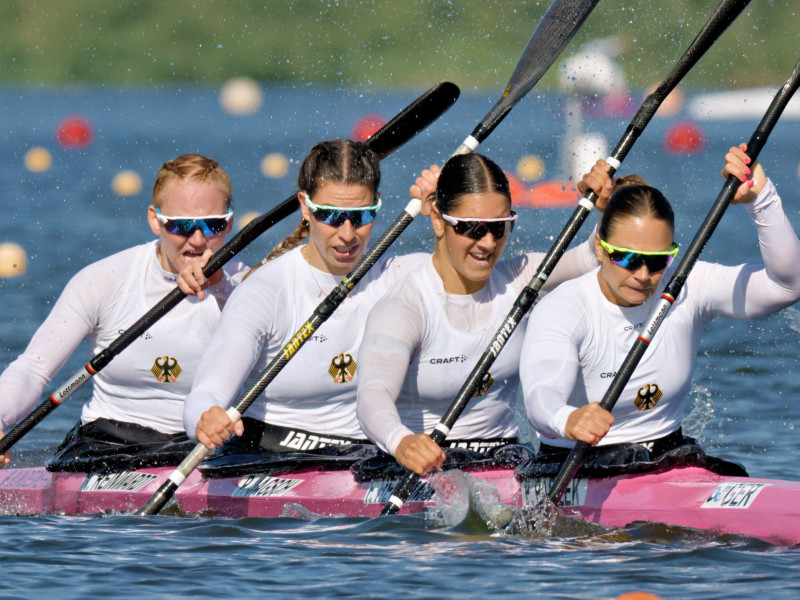
Germany also took bronze in the Women’s K4 500m, where Jagsch joined Paulina Paszek, Finja Hermanussen and Nele Reinwardt to finish behind China and Spain.
That means Jagsch herself already has two medals in Poznań: individual K1 gold and K4 bronze, with another medal opportunity still to come in the K2.
There is an additional significance to Germany’s results.
The Men’s K4 500m, Women’s C2 500m and Women’s K1 500m are all part of the Olympic programme.
And the 2026 World Championships carry additional importance in the international ranking towards Los Angeles 2028, with the German federation highlighting the increased weighting of the points available in Poznań.
In that context, three World Championship titles in Olympic disciplines represent much more than a strong medal tally.
The experienced men’s K4 continues to deliver.
A new women’s C2 has emerged at world level.
And in Pauline Jagsch, Germany increasingly appears to have found an athlete capable of leading its women’s kayak programme individually as well as in crew boats.
Before coming to Poznań, Jagsch said her ultimate ambition remained clear: to become an Olympic champion.
Los Angeles is still two years away.
But after European gold in June and World gold in August, that ambition suddenly looks considerably less distant.
In 2018, Poznań showed Pauline Jagsch what international canoe sprint looked like. Eight years later, she has returned to the same waters and shown the world what Pauline Jagsch can become, while her family was watching from the stands.


© 2021 ECA