We use cookies to improve our site and your experience. By continuing to browse our site you accept our cookie policy
We use cookies to improve our site and your experience. By continuing to browse our site you accept our cookie policy
 25.9.2026
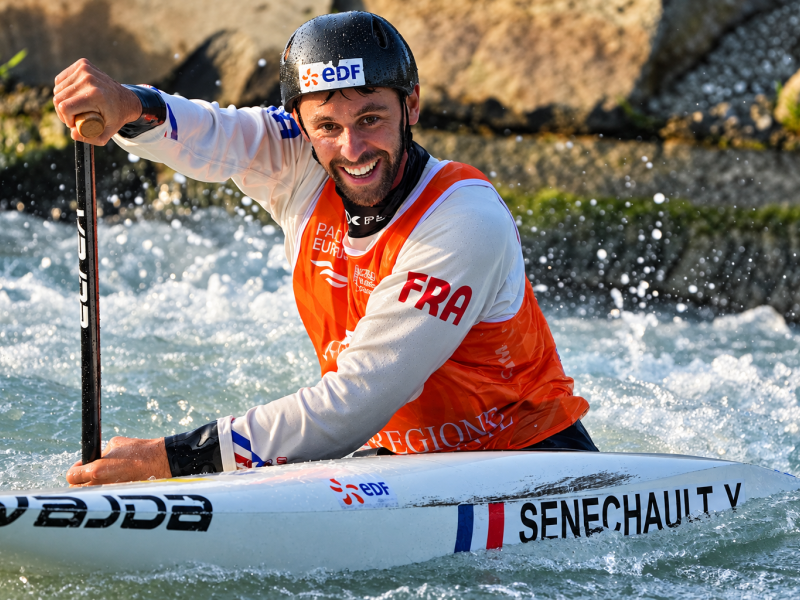
The French paddler produced a clean 90.26-second run to take gold, finishing 1.44 seconds ahead of semifinal winner Lukas Kratochvil and 2.19 ahead of Italy’s Elio Maiutto.
Kratochvil secured silver for Czechia, while Maiutto gave the home crowd another reason to celebrate with bronze.
For Senechault, it was the perfect conclusion to a competition in which he had already shown his speed by qualifying second from the semifinal.
Senechault had been one of the strongest athletes throughout Friday afternoon.
He qualified second from the semifinal with a clean 91.00, only 0.82 behind Kratochvil.
But when the medals were decided, the French paddler found another level.
His final time of 90.26 was 0.74 seconds faster than his semifinal run and, crucially, completely clean.
No one could match it.
Kratochvil came closest with 91.70, but even the semifinal winner finished 1.44 seconds behind.
It was a decisive performance in a final full of Olympic, World and European medallists.
Lukas Kratochvil entered the final as the fastest athlete from the semifinal.
The Czech paddler had produced a clean 90.18 earlier in the afternoon and looked perfectly positioned to challenge for the title.
In the final he remained clean again, but his 91.70 was not enough to hold off Senechault.
Silver nevertheless completes another major result for Kratochvil after his World Championship bronze earlier this season.
Across semifinal and final, he produced two clean runs and confirmed himself as one of the most consistent men in the field.
Elio Maiutto completed the podium and continued an exceptional day for the host nation.
The Italian had already shown impressive raw speed in the semifinal, where a two-second penalty left him third. In the final, the touch disappeared.
Maiutto delivered a clean 92.45, securing bronze and finishing just 0.75 seconds behind Kratochvil.
The result added another medal to Italy’s increasingly impressive Friday.
Earlier in the day, Lucia Pistoni took silver in women’s K1, while Xabier Ferrazzi and Giovanni De Gennaro finished second and third in men’s K1.
Maiutto’s bronze therefore became another major home result in front of the Ivrea crowd.
Nicolas Gestin arrived in the final as one of the biggest names still in contention.
The Paris 2024 Olympic champion had qualified comfortably from the semifinal in fourth position and was one of three French athletes in the medal race. His final was clean. His 92.69 was also competitive.
But it left him fourth, only 0.24 seconds behind Maiutto and outside the medals.
It was another example of how small the margins became once the penalties disappeared from the leading runs.
France nevertheless leaves the final with the title through Senechault and two athletes inside the top six.
One of the most interesting performances belonged to Marko Mirgorodsky.
The Slovakian recorded a raw time of 91.57, which would have been enough for second place.
But a two-second penalty increased his total to 93.57 and dropped him to fifth.
Without the touch, Mirgorodsky would have finished only 1.31 seconds behind Senechault and ahead of Kratochvil.
It was perhaps the clearest example of how one small mistake changed the medal picture.
Jules Bernardet was another athlete with enough raw speed to reach the podium conversation.
The Frenchman recorded 91.39, faster than Kratochvil’s silver-medal total and Maiutto’s bronze-medal time.
But four penalty seconds lifted his result to 95.39 and left him sixth.
France therefore had the raw speed to place two athletes very high in the classification, but only Senechault managed to produce the combination of speed and precision required for the title.
The second half of the final was dramatically reshaped by 50-second penalties.
Raffaello Ivaldi had been one of Italy’s two finalists and recorded a raw 92.32, which would have placed him close to the medal positions.
But a 50-second penalty increased his total to 142.32 and left him tenth.
Adam Burgess suffered the same fate.
The Paris 2024 Olympic silver medallist finished with a raw 96.07, but a 50-second penalty pushed his total to 146.07 and 11th place.
Thomas Koechlin was also heavily penalised, receiving 52 seconds and finishing 12th.
Three finalists therefore saw their medal opportunities effectively disappear through major penalties.
The shape of the final had already changed dramatically before the first athlete started.
Reigning World champion and defending European champion Miquel Travé had been eliminated in the semifinal after four penalty seconds dropped him to 15th.
That guaranteed a new European champion.
Ziga Lin Hocevar, the 2024 European champion, had also missed the final, along with Benjamin Savsek, Luka Bozic and Matej Benus.
What remained was a very different title race.
Kratochvil entered as the semifinal winner.
Gestin carried the Olympic title.
Burgess brought Olympic silver.
Maiutto carried Italian hopes.
But it was Senechault who produced the cleanest and fastest decisive run.
The final podium:
Yohann Senechault (FRA) — 90.26
Lukas Kratochvil (CZE) — 91.70 (+1.44)
Elio Maiutto (ITA) — 92.45 (+2.19)
For France, the victory adds another title to an already successful Championships.
For Kratochvil, silver confirms another major international result in a season that has already brought him a World Championship medal.
For Italy, Maiutto’s bronze adds another home medal to a memorable Friday in Ivrea.
And for Senechault, the final provided the defining moment. He was second in the semifinal. He was fastest when it mattered.
Yohann Senechault is the new European men’s C1 champion — and he closes Day 2 in Ivrea with gold for France.



© 2021 ECA